.png "white on transparent (1)")
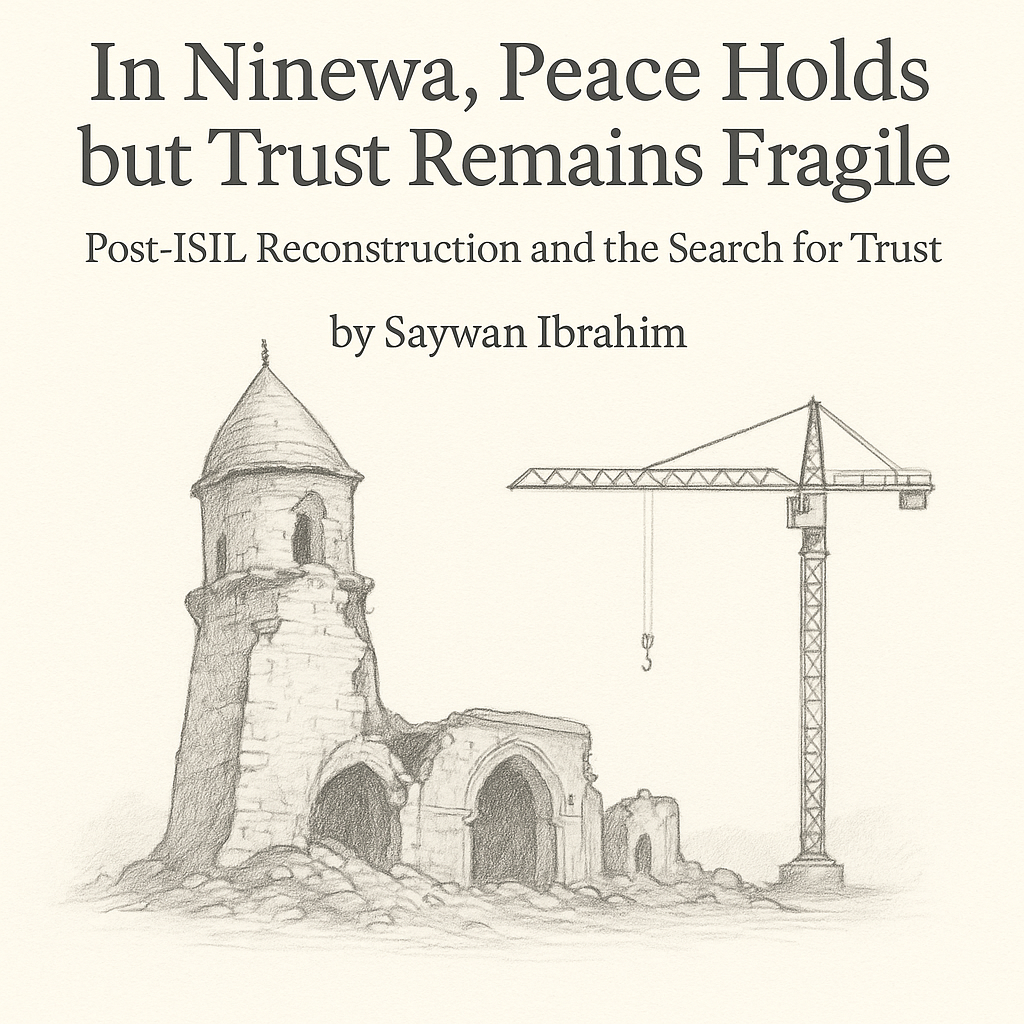
Eight years after the defeat of Islamic State in Iraq and Levant (ISIL), life in Ninewa is inching back to normal. Reconstruction of landmarks such as Mosul Airport and the Al-Nuri Mosque offers glimpses of renewal. Yet mistrust and division still run deep. Stability remains fragile, communities and authorities continue to struggle with return, justice, and the difficult work of building a shared future.
This article opens a series of analytical pieces on Ninewa’s enduring challenges—return and reintegration, disputes over identity and belonging both intra- and inter-communal, security, political exclusion, and the search for peace and justice, as well as my reflections and observations from a decade of working on and covering the region as a researcher, advisor, and consultant to local authorities and international organizations.
War and Aftermath
Since the ISIL conflict began, I have worked across crisis response, humanitarian access and safety, and peacebuilding—monitoring developments during the conflict and in its aftermath, while responding to the humanitarian crisis in Ninewa province and the Kurdistan Region. I closely witnessed its impact. The burning of libraries, universities, schools, temples, and archaeological sites by ISIL carried the shock of a harbinger of cultural devastation, erasing centuries of history and memory. In the aftermath of ISIL's defeat, I have continued to work closely with communities across Ninewa and the region where the wreckage of infrastructure and the trauma of war remain visible today.
On June 10, 2014, the Islamic State in Iraq and Levant (ISIL) swept into Ninewa Province and declared Mosul its capital. More than a decade later, the province is still grappling to recover from the consequences—rebuilding shattered cities, towns and villages while struggling to restore trust among communities divided by years of war.
To the people of Ninewa, the cost of war is not only measured in ruined neighborhoods, displacement, contaminated land, and the threat of ISIL holdouts. It also sharpens an unsettling question: how did Iraq’s second-largest city, defended by multiple army divisions, collapse in a matter of hours? Moslawis remember how Sunni officers were sidelined and replaced by Shia commanders from Baghdad—moves that fractured trust between residents and the security forces. That mistrust, more than battlefield weakness, paved the way for the city’s fall. The fear that it could happen again still haunts Ninewa, especially among minority groups, giving rise to what I describe as a resistance identity. Even as confidence in the security forces has improved since 2014, the sense of vulnerability endures.
Today, the province enjoys a measure of stability. Car bombs and assassinations no longer dominate headlines. According to the International Organization for Migration, more than 1.9 million internally displaced people have returned to 1,022 locations in Ninewa, while over 570,000 remain displaced. Yet beneath the calm lies a patchwork of security forces—federal units and local armed groups, each tied to specific constituencies. Cities and towns remain ringed by checkpoints and military outposts. To some, this system signals resilience; to others, it underscores fragility and a lack of trust, with authority fragmented across competing powers rather than unified under the state. The heavy security presence in Sinjar, Telafar, and along the KRG–federal demarcation line raises questions of necessity and opens doors to corruption.
The withdrawal of international organizations, whose development, peacebuilding, and social cohesion programs remain urgently needed, has only deepened this vulnerability.
Diversity and Division
Ninewa is often described as a “small Iraq” for its diversity. Ezidis, Sunni and Shia Muslims, Chaldeans and Assyrians, Turkmen, distinct Kurdish tribes such as the Gargari and Shabak, and Arab tribes like the Shammar and Jubour all share the province. That same diversity also made it vulnerable. Extremist groups—first Al-Qaeda, then the ISIL—exploited these divisions through genocidal attacks on Ezidis, massacres of Shia families and the exile of Christians. The campaigns tore at Ninewa’s social fabric, leaving deep mistrust that endures today.
Today, while authorities have prioritized the physical rebuilding of towns and infrastructure, initiatives to reintegrate returnees, strengthen education, promote dialogue, counter hate speech and offer sustainable alternatives to violence have not received equal attention until recently with the Federal Government’s new Strategy of Countering Violent Extremism, which is yet to be implemented. Instead, the government has leaned on deterrence and a strong security grip over the province.
When I traveled through Sinjar, Tel Afar and Mosul in August 2025, the traces of war were still visible everywhere: towns scarred by violence, mass graves left as silent witnesses. Climate change added another layer of fragility. The Tigris River is shrinking, orchards and farmlands abandoned, weakening the economic base for returnees. Last summer, when I visited the same area, the Abu Mariya Spring formed a small circular pond beside an ancient archaeological hill, providing water and livelihood for nearby households and farmers. This year, when I passed by, the pond was gone and the small stream that once crossed the village had completely dried up. Local scarcity is worsened by Baghdad’s failure to secure Iraq’s fair share of the Tigris from Türkiye.
The road to Sinjar is lined with checkpoints run by rival forces, each a reminder of fractured authority and the lingering shadow of war. Oversized posters of political leaders, commanders, and fighters killed in the battle against ISIL cover entrances and roadblocks. Banners praising security forces still hang from walls and gates. At every stop, civilians must account for their movements.
A road diverging from Highway 47, running through a constellation of Ezidi and Arab villages stretching some 55 kilometers, contains nine checkpoints and numerous outposts manned by different security actors. Iraqi and KRG flags flew alongside banners affiliated with Ezidi groups.
A member of the community told me he often changes his story depending on who mans the post—his affiliations, political ties or even the reason for his trip. “Basically, I have to prove I am a good man every day,” he said. “Otherwise, I will be turned back.” These checkpoints symbolize not just security, but also the enduring mistrust between citizens and the state.
Return and Its Fault Lines
The process of return highlights many of Ninewa’s challenges. Buses now bring families—often stigmatized as “ISIL families”—from Al-Hol Camp in Syria under heavy security. Their arrival stirs anxiety in communities scarred by ISIL atrocities and is seen by some as a political gesture ahead of elections rather than part of a national reintegration strategy. By August 15, 2025, more than 25,000 Iraqi nationals had been repatriated from Al-Hol, with most originally from Anbar Salah al-Din and Ninewa. returnees are first received at the Al-Amal center (located south of Mosul) before their return to their areas of origin, a process that adds to local unease about the pace and management of returns. In 2024 alone, Iraq increased the number of citizens repatriated from the Al-Hol and Roj camps by 165 percent compared with the previous year.
The passage of the Amended Amnesty Law No. 27 of 2016 by the federal parliament has further complicated the return process, deepening doubts about the state’s commitment to holding individuals involved in ISIL atrocities accountable. According to the Supreme Judicial Council, more than 33,500 people have been deemed eligible for amnesty since its enactment in January 2025.
Ezidi families returning from camps in the Kurdistan Region face different barriers. Many leave relatives or possessions behind, doubting long-term safety in Sinjar, where unresolved disputes between Erbil and Baghdad over security and administration have left the district in an administrative vacuum since October 2017. Tensions deepened in April 2023 when the local authorities attempted to return a number of Sunni Arab families perceived as having ISIL affiliations to Sinjar, a move resisted by Ezidis.
Across Ninewa, communities question whether return and reintegration can succeed without first addressing the stigma attached to returnees, the fear surrounding their presence, and the weakness of local governance.
In Ayadiya, a Sunni Turkmen-majority town, I met an elderly man holding a plastic bag of family IDs outside a government office. He hesitated to go in, fearing questions about relatives accused of ties to the Islamic State. His hesitation is not unusual: many returnees remain caught between official promises of compensation and the undercurrent of suspicion that shadows their lives.
Memory and Justice
In Ezidi areas, memory itself has become politicized. Posters displayed at checkpoints, village gates and marketplaces on the 11th anniversary of the Ezidi genocide denounce the absence of justice: “The delay in transitional justice is another genocide against the Ezidis.” Others strike a tone of defiance: “Our memory is stronger than genocide attempts.”
In Khanasur, a small town on the border with Syria, hundreds of photographs of those killed defending their communities hang on both sides of the main street, serving as both a source of pride and a reminder of the cost of survival. At the same time, hate-speech campaigns that justify violence against Ezidis on religious grounds continue without legal consequences from both the federal government and the KRG.
In the absence of implementation of formal justice, memory has become the primary vehicle for dignity and resistance. Laws to protect the cultural, religious and ethnic identity of minorities remain unanswered demands—whether criminalizing hate speech against minority groups, formally recognizing the genocide of Ezidis and other communities, or ensuring their long-term protection. For many Ezidis, the uncertainty and neglect surrounding these measures reinforce their sense of marginalization.
Elsewhere in teahouses and marketplaces across Ninewa, politics dominates conversation. Tribal leaders, teachers, taxi drivers, students and farmers all speak of the same subject. The parliamentary elections scheduled for Nov. 11, 2025, are met with skepticism, especially the contests over minority-reserved seats for Ezidis, Turkmen and Christians. Many view these maneuvers as detached from daily realities while war-related problems remain unresolved.
At the same time, the exclusion of youth and women from decision-making shows how political life remains closed, even as unemployment rises and opportunities remain scarce.
Divided Narratives
Events beyond Iraq add to this unease. The shift in power in northern Syria in December 2024 carried different meanings for different groups in Ninewa. For some, it was seen as a regime change with uncertain implications. For Ezidis and Shia communities, it raised fears of renewed extremism. Others regarded it as another turn in the region’s shifting dynamics. For minorities in particular, the violence directed against Alawites and Druze deepened the sense that they, too, remain vulnerable. Either way, it reinforced Ninewa’s exposure to forces beyond its borders.
Traveling across the province since 2016, I have seen how little has changed beyond the edges of Mosul. What struck me most in 2025 was how clearly each community spoke about its own struggles—Ezidis about justice and protection, Turkmen about security and stability, Christians about displacement, Shia about extremism, and Sunnis of a dignified and safe return to their areas—yet how rarely they acknowledged the suffering of their neighbors. The knowledge of one’s own wounds runs deep; the understanding of others’ remains shallow.
This community isolation keeps Ninewa’s social cohesion fractured. Communities remain locked in separate narratives, weakening the prospects for reconciliation. Yet there is a counterpoint. In conversations, many also acknowledged past mistakes and the need to move forward. That recognition—limited though it may be—offers a measure of hope. For all its fragile stability, Ninewa’s future will depend on whether its communities can look beyond their own wounds and recognize each other’s. No single group can rebuild Ninewa alone.


.jpeg "TV ALYAUM Features CSIORS and Expert Issam Khoury")